Mimosa Hostilis for Dye Workshops: How Much Bark to Buy for 5, 10, or 20 Participants
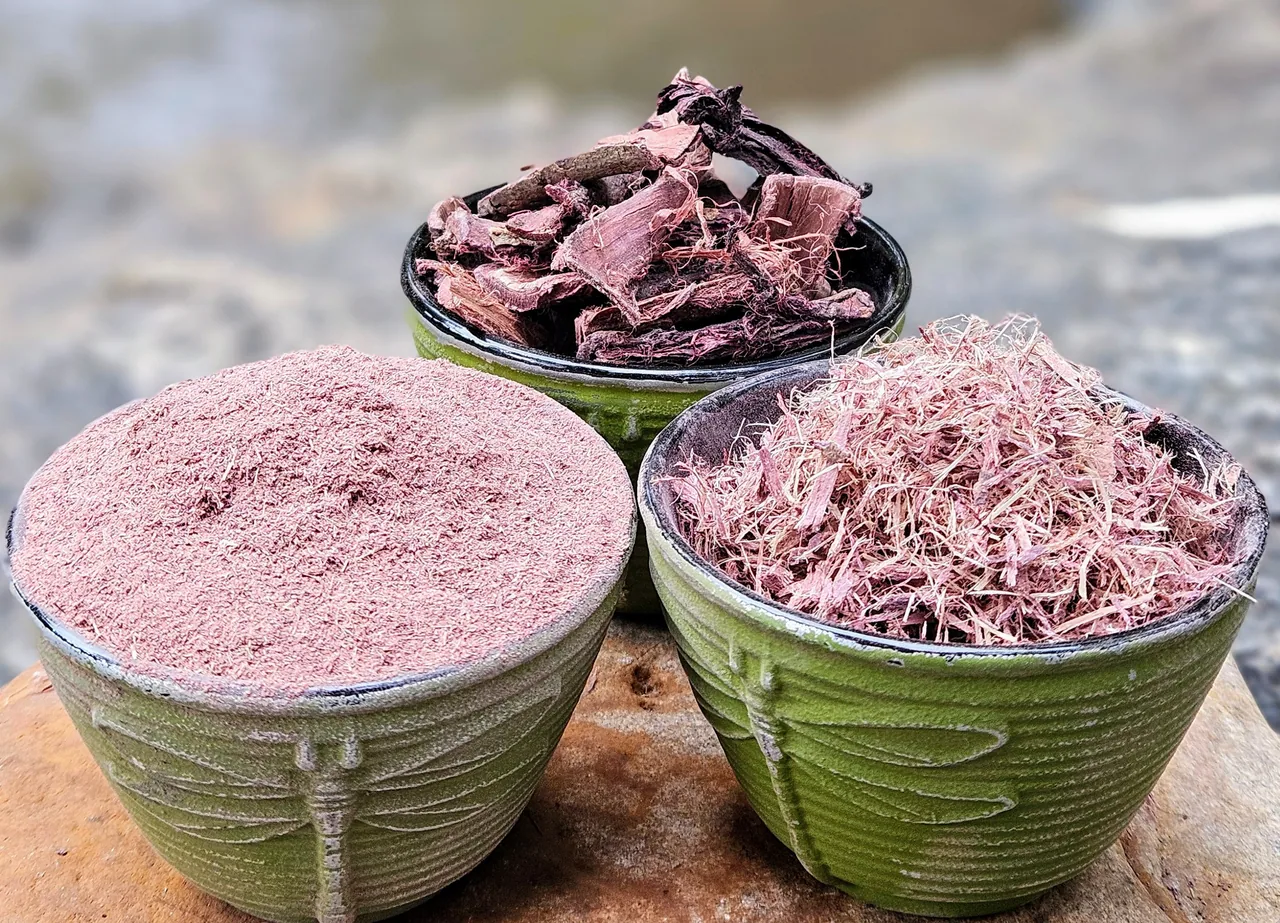
A practical estimate for facilitators: state the dry-fiber assumption, calculate the bark first, and only then choose a package size.
Workshop quantities are easier to plan when the assumptions are visible. The examples below assume that each participant will dye 100 g of dry fiber and use a starting amount of bark equal to 75% of the total dry-fiber weight. That is a planning example, not a standard requirement or a promise of a particular shade.
Start with each participant’s dry fiber
Weight of fiber (WOF) compares the dry weight of the material being dyed with the weight of dye material. At 75% WOF, multiply the total dry-fiber weight by 0.75. For example, 500 g of dry fiber × 0.75 = 375 g of bark.
The 100 g per-person figure is an explicit workshop assumption, not a claim that every participant needs the same amount. If your class will dye larger pieces, use the actual planned dry-fiber weights instead.
Calculated bark and package rounding are different numbers
With 100 g of dry fiber per participant, the math is 375 g for 5 people, 750 g for 10 people, and 1,500 g (1.5 kg) for 20 people. Those are the calculated amounts at 75% WOF.
If choosing one next-up package size, 500 g, 1 kg, and 2 kg are each one-third above those calculations: 125 g, 250 g, and 500 g extra respectively. That is a clear package-size buffer, not a small rounding difference. Available package combinations can land closer to the calculation; compare current shredded-bark options before ordering.
If each participant plans 150 g of dry fiber
Recalculate from the larger project instead of reusing the 100 g examples. Five people would bring 750 g of dry fiber, so 75% WOF is 562.5 g of bark. A 500 g plus 100 g combination totals 600 g, which is 37.5 g (about 6.7%) above the calculation.
For 10 people, 1.5 kg of dry fiber requires 1.125 kg of bark at 75% WOF. A 1 kg plus 250 g combination totals 1.25 kg, 125 g (about 11.1%) above the calculation. For 20 people, 3 kg of dry fiber requires 2.25 kg of bark; 2 kg plus 250 g matches that amount.
Shared bath or separate projects?
The totals above add up the participants’ dry-fiber weights. They can help estimate material for a shared bath when the group is using compatible fibers and a common process. A shared vessel still needs enough capacity for the water, fiber, and room to move the materials.
If participants run independent baths, calculate each project from its own dry-fiber weight and add those estimates. Each bath also needs its own vessel, water, and process time; a combined bark total does not mean the work can all happen in one pot.
Treat WOF as a starting point, not a shade forecast
A 75% WOF calculation helps you budget material, but it cannot predict a finished color. Fiber type and preparation, mordant, pH, water chemistry, extraction, and the bark itself all affect results. Make a small test when repeatability matters and adjust from what you observe.
A different target ratio changes the estimate directly: 50% WOF uses 50 g of bark per 100 g of dry fiber, while 100% WOF uses 100 g. Use a ratio that fits your own tested process rather than assuming one workshop formula suits every group.
Choose a form that works for teaching
Shredded bark releases color steadily and is easier to strain than powder, which makes it a useful form for first-time fabric-dyeing sessions. A second or third extraction may produce a lighter bath; plan for that as an additional color stage, not an equal-strength replacement.
Compare the current shredded-bark sizes on the workshop buying page. For larger orders across forms, the bulk page lists 2 kg, 3 kg, 5 kg, and 10 kg options.
Choose a workshop size
Compare shredded root bark sizes for workshops · View the 500 g shredded-bark option · View the 1 kg shredded-bark option · View the 2 kg shredded-bark option · Compare 2–10 kg bulk sizes across all root-bark forms · Read the broader guide to estimating bark for a project
Need help comparing a workshop quantity? Contact Violet Dye Co.