Mimosa tenuiflora & Nitrogen Fixation in Drylands
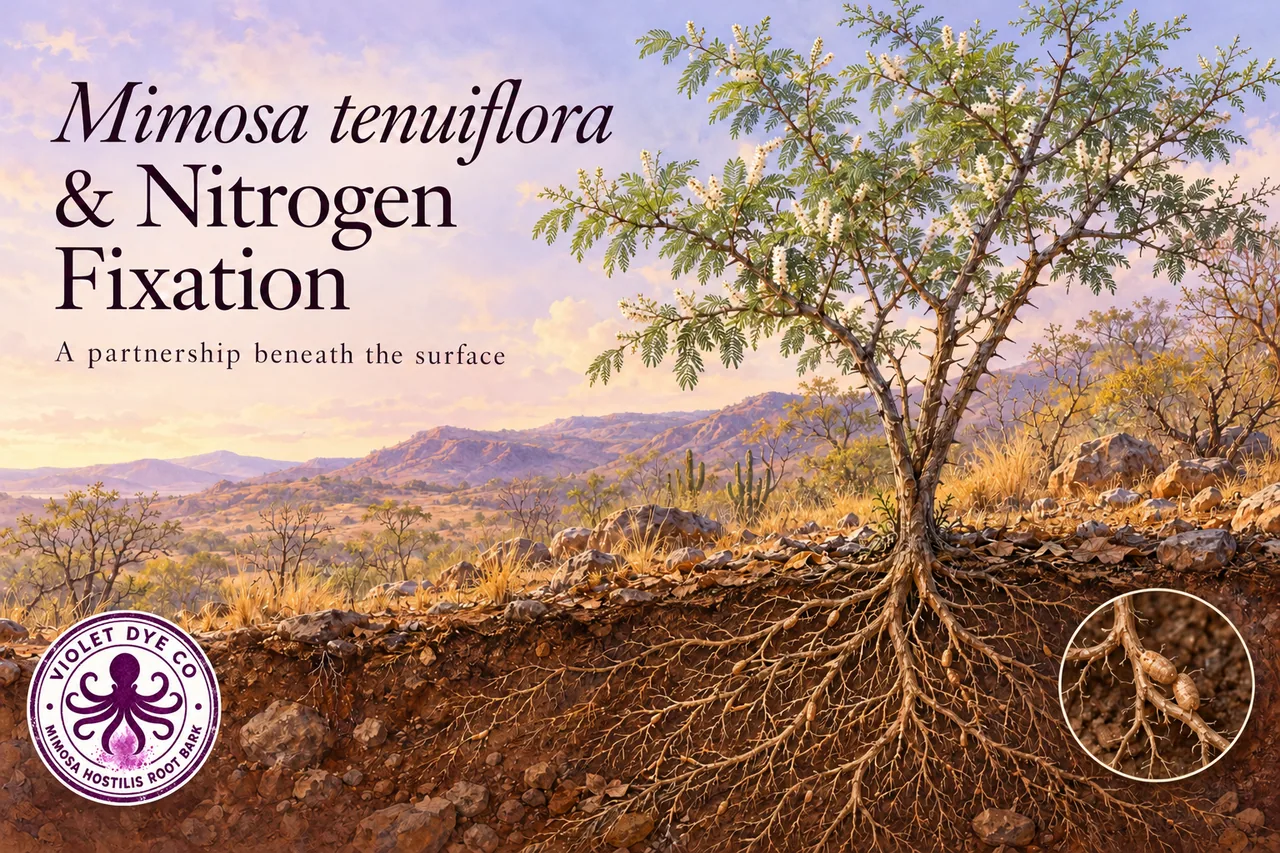
Mimosa hostilis—also known by the accepted botanical name Mimosa tenuiflora, and by names such as jurema preta and tepezcohuite—is a legume associated with dry landscapes in parts of the Americas. Research in Brazil’s Caatinga documents nitrogen-fixing partnerships in this group of plants. That is an important ecological process, but it does not mean every tree adds the same amount of nitrogen or automatically restores the soil around it.
First, nitrogen fixation is a partnership
Most plants cannot use nitrogen gas (N₂) directly from the air. In nitrogen fixation, specialized bacteria use the enzyme nitrogenase to convert atmospheric nitrogen into compounds that plants can use. In legumes, compatible bacteria can live in small structures called root nodules. The plant supplies the bacteria with energy from photosynthesis; the bacteria provide usable nitrogen in return.
Studies of Brazilian Mimosa species have found nodules and evidence of nitrogen fixation. One field study reported that biological nitrogen fixation contributed up to 60% of total plant nitrogen in some Caatinga Mimosa samples. That result describes the plants and conditions measured in that study—not a guaranteed rate for every Mimosa tenuiflora tree or every location.
How nitrogen moves from a tree into soil
Fixation first benefits the plant and its bacterial partners. Nitrogen can later enter the surrounding ecosystem as leaves, fine roots, and other plant material turn over and decompose. Soil organisms break that material down, and some of its nutrients can become available to other plants. The timing and amount depend on the plant, microbes, moisture, temperature, soil chemistry, and the wider plant community.
That is different from saying a living tree directly fertilizes all nearby soil. It is also different from a bagged fertilizer: nitrogen cycling happens through ecological relationships and decomposition, and its effects can be gradual and uneven.
What studies in the Caatinga found
A study of tropical dry-forest sites in northeastern Brazil compared areas at different stages of regeneration with old-growth Caatinga. The researchers found that nitrogen fixation by the plants they examined was absent or very low in the 16- and 38-year regenerating areas. In old-growth forest, nitrogen-fixing species—including M. tenuiflora—derived a substantial share of their plant nitrogen from the atmosphere. Yet the estimated amount fixed across the old-growth forest was modest because those species made up a relatively small part of the vegetation.
The takeaway is not that the tree never fixes nitrogen, nor that it always enriches a site. It is that nitrogen fixation is real, while its contribution to an ecosystem depends on active bacterial partners, local conditions, the tree’s abundance, and the stage and composition of the surrounding forest.
Does that make it an environmental “fix”?
It can be one part of nutrient cycling in the places where the tree grows. As a species able to establish in some challenging dryland conditions, M. tenuiflora is discussed in research about Caatinga ecology and restoration. But the presence of one nitrogen-fixing species is not, by itself, proof that a landscape has been restored or that planting it is right for every site.
Restoration decisions need local ecological knowledge: which species belong in that habitat, what is limiting recovery, and how planting affects the existing community. Nitrogen fixation should not be confused with carbon sequestration, a climate-impact claim, or a blanket claim that the tree “repairs” degraded land.
Ecology and bark harvesting are separate questions
A tree’s nitrogen-fixing ability does not establish how a particular bark harvest affects it, how quickly it recovers, or whether a supplier’s sourcing practices are sustainable. Those questions need evidence about the harvest method, the individual tree, and the local population. Our separate guide explains what selective root bark harvesting involves; for botanical names and regional context, see The Many Names of a Root.
Research cited
- dos Reis Jr. et al. (2010), “Nodulation and nitrogen fixation by Mimosa spp. in the Cerrado and Caatinga biomes of Brazil.”
- de Souza et al. (2012), “How much nitrogen is fixed by biological symbiosis in tropical dry forests? 1. Trees and shrubs.”
- “Paraburkholderia spp. are the main rhizobial microsymbionts of Mimosa tenuiflora in soils of the Brazilian tropical dry forests” (2021).
These studies focus on Brazilian dry-forest systems. They provide useful evidence about the species and its nitrogen-fixing partners, but they are not a substitute for site-specific ecological assessment.