What Is a Lake Pigment? The Chemistry and History of Dye into Paint
A colored liquid, a collected pigment, and a finished watercolor are three different materials.
Leave a lake-pigment trial undisturbed and you may see fine material gathering at the bottom of the container. That change invites a question: what have you collected?
It is not enough to call every layer of sediment a successful lake pigment. But when a soluble colorant becomes associated with an insoluble material that can be collected and used as pigment, you have entered the practice of lake-making.
The lake is the pigment. It becomes paint when combined with a suitable binder. Our companion small-batch Mimosa lake-pigment guide proposes a practical trial; this article explains the chemistry, historical context, and limits of the evidence.
Why “lake”?
The name is connected to lac, a historic insect-derived colorant—not to a body of water. The term eventually came to describe a broader category of pigments made from organic dyes. [1]
That category includes materials made from plants as well as insects. Madder, cochineal, and brazilwood all appear in documented lake-making practice, although their colorants and preparation methods differ. [2]
From dissolved color to colored particles
A well-strained bark extract can remain strongly colored after its visible plant fibers have been removed. Filtering it again through the same kind of paper will not, by itself, reliably capture colorants that remain dissolved.
Lake-making changes that situation.
In many traditional and modern methods, a dye becomes associated with an insoluble, aluminum-containing material. Some methods involve metal–colorant complex formation, adsorption onto a substrate, or processes occurring together. “Dye attached to a carrier” is a useful introduction, but it is not a complete chemical description of every lake pigment. [2]
In an alum-and-carbonate method, alum provides aluminum in solution. Adding a carbonate changes the acidity and chemical conditions, allowing an aluminum-containing precipitate to form. Colorant may become associated with the resulting solid.
The precise result depends on the dye mixture, chemical forms and amounts, pH, and preparation conditions. A homemade Mimosa trial does not reveal that composition simply by producing sediment.
What the two filters tell you
The practical guide uses filtration at two different stages.
Before lake-making, the filter removes bark fibers and other suspended debris. The colored liquid is the part you keep.
After precipitation, the filter collects newly formed insoluble material. The washed solid becomes the material you evaluate for paint.
Starting with a gritty extract makes this distinction harder: bark particles can end up mixed with the precipitate.
The quantity of sediment can also be misleading. A substantial layer may contain considerable mineral material but relatively little colorant. That is why a brushstroke is a better test of usable color than the apparent volume of paste in the jar.
Why paintmakers used lakes
Soluble dyes can make marks on paper, but painters also needed colorants that could be handled as particles and combined with different binding media.
Lake-making offered ways to use organic colorants in paint. Many historical lakes were valued for their transparency and use in layered painting, including glazes over other colors. Their behavior depended on the colorant, substrate, preparation, and paint medium—not merely on being called a lake. [2]
Historical practice was not one universal recipe.
The Making and Knowing Project’s madder reconstruction uses alum and potash, potassium carbonate. Historical recipes also include other routes and sources, including extracting color from dyed textiles rather than directly from raw plant material. [2] [3]
Rutgers’ The Motley Emblem documents a modern reconstruction of a brazilwood lake informed by historical practice. Its record includes recovered pigment mixed with gum-water: a useful example of two separate operations—first obtaining pigment, then making paint. [1]
Where Mimosa fits—and where the evidence stops
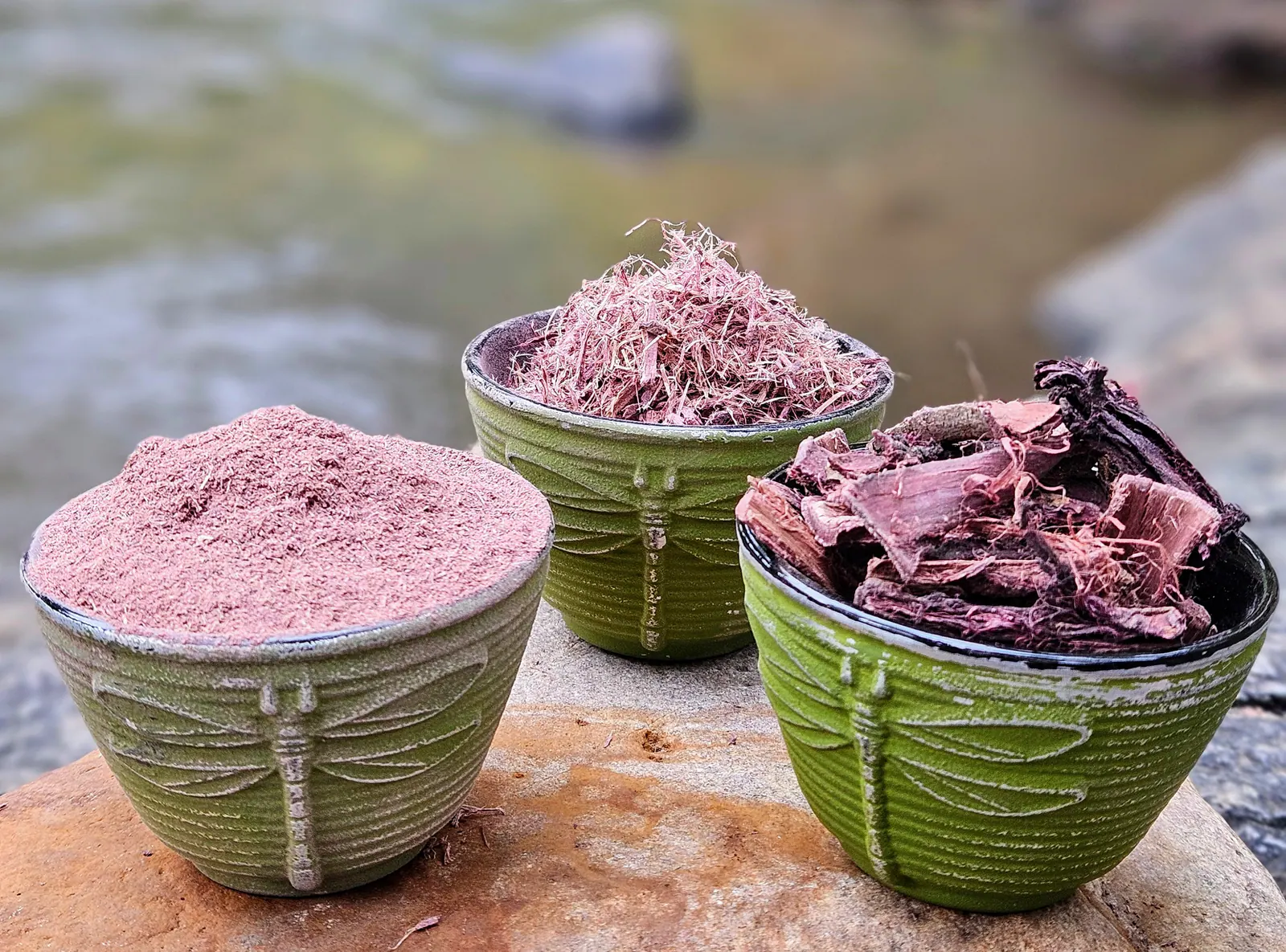
Mimosa hostilis is an older botanical name for Mimosa tenuiflora. Our naming guide introduces those names and Tepezcohuite. Its bark provides a material for exploring how plant extracts respond to metal salts and changing conditions.
A textile study using commercial M. tenuiflora bark-extract powder discusses condensed tannins and reports different color results after treatment with different metal-salt mordants. [4]
That supports a limited point: the extract’s behavior can change with its treatment.
It does not establish:
- The exact composition of our Mexican inner-root-bark extract
- A validated alum-and-soda-ash recipe for that bark
- A predictable lake-pigment yield or finished hue
- The lightfastness of a homemade Mimosa watercolor
The textile study is background evidence, not a craft recipe or a recommendation to use all the salts examined in its experiments.
There is a historical boundary too. Lake-making has a documented history, but the sources used here do not establish a historical tradition of making paint with this exact Mimosa inner-root-bark method. Our Tepezcohuite history article similarly separates evidence for modern textile work from unconfirmed historical claims.
The practical guide in this series is therefore a modern, proposed experiment, not a reconstruction of a documented historical Mimosa recipe or a report of completed Violet Dye Co testing.
Soda ash is not baking soda
Our fabric-dyeing guidance discusses baking soda as a possible pH modifier. The lake-pigment trial uses soda ash as part of the precipitation process.
Those names refer to different chemicals:
- Baking soda: sodium bicarbonate
- Soda ash: sodium carbonate
They should not be substituted gram-for-gram merely because both are alkaline. Likewise, potassium alum and aluminum sulfate should not be treated as identical materials in a measured recipe.
Recording the actual chemical product matters more than recording a loose name such as “alum.” Our mordanting guide concerns preparing fabric; that is a different application from making a lake pigment.
Insoluble does not mean lightfast—or waterproof
Collecting an insoluble colorant tells you something about its behavior in water. It does not establish how it will withstand light.
A study of other plant-derived lake pigments used in water-based printing inks reported lightfastness values of 1–3 on the Blue Wool Scale. Those results illustrate why a successfully formed pigment may still be light-sensitive; they are not a lightfastness rating for Mimosa watercolor. [5]
Paint behavior also depends on the binder. A gum-arabic watercolor may rewet even when its pigment is relatively insoluble. Lake-making does not automatically produce waterproof paint.
For a first experiment, a labelled sketchbook sample is more informative than an archival claim. Record the material, process, binder, and date. Treat any informal exposure comparison as an observation—not a substitute for standardized lightfastness testing.
Return to the worktable
The practical guide, Making Lake Pigment from Mimosa Root-Bark Dye: A Small-Batch Trial, starts with two marks: plain bark dye and a paint sample made from the collected precipitate.
That comparison cannot identify every compound in the jar. It can show whether the material is useful to you: how it handles, how it dries, and what color it leaves on paper.
Those observations are a sound starting point for the next measured trial.
Sources
- Rutgers — The Motley Emblem: Lake. Modern historical reconstruction, the lac connection, and pigment mixed with gum-water.
- Jo Kirby, Marika Spring, and Catherine Higgitt — The Technology of Red Lake Pigment Manufacture: Study of the Dyestuff Substrate. National Gallery Technical Bulletin, volume 26 (2005). Analysis of historical lake substrates and reconstructed recipes.
- Making and Knowing Project — Lake Pigments from Madder Root. A madder reconstruction using alum and potash.
- Dyeing of White and Indigo Dyed Cotton Fabrics with Mimosa tenuiflora Extract. Textile research, published online in 2011; not a lake-paint trial.
- Natural Lake Pigment Extraction: Sustainable Production of Plant-Based Pigments for Water-Based Inks and Their Printability Potential. Research on other plant lakes in printing inks, not a Mimosa watercolor rating.